


Happy Wednesday,
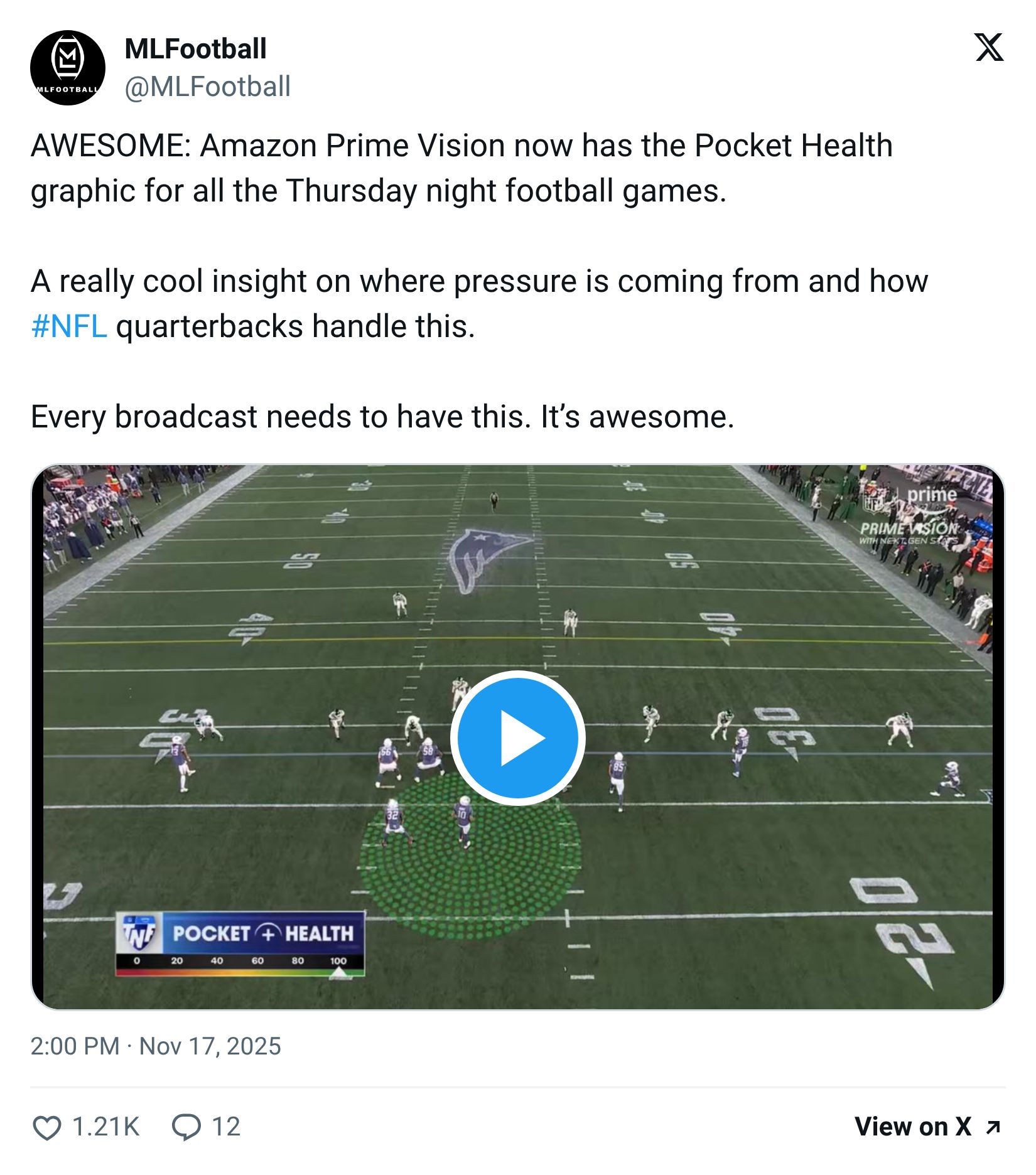
This week, Jake and I talked with Sam Schwartzstein, the voice of Prime Vision, Amazon's stat-forward alternate broadcast.
Before he was on TV breaking down all those data visuals, he was a center at Stanford for Andrew Luck and Jim Harbaugh, an early XFL hire, and one of the people behind the eventual redesign of the NFL's dynamic kickoff. He changes football on the field and on your screen the same way: diagnose the problem, test the fix, and let the data decide what works.
In our conversation this week, we got into what it takes to reinvent a game without losing what makes it football, how technology is changing the way fans watch, and why some problems might be better left unsolved.
You can catch Sam this Friday at 3 p.m. Eastern on Prime Vision's Black Friday broadcast of the Broncos and Steelers.
We don't use AI just for the sake of using AI. We're going to try and solve the viewer’s problem.
How Sam Got Here
2008-2012: Sam was a center at Stanford, where he played for Jim Harbaugh and Andrew Luck. He was the guy trying to predict which defenders would blitz.
Silicon Valley: He went into product management with Chegg in the Bay Area, where the philosophy was build, test, repeat. Around 14 years ago, he and a friend with a PhD in machine learning and computer vision tried building early computer vision models for football. The technology just wasn't there yet.
The XFL: Vince McMahon and Oliver Luck wanted to reimagine the game in 2018. When McMahon launched the league the first time in 2001, he threw everything at the wall to see what stuck. Sam was the opposite, and Luck told him to do it his way: diagnose the problems before trying to solve them.
The kickoff diagnosis: Sam polled about 6,000 fans, and the feedback was that the kickoff had become a bathroom break. It was also dangerous: he says players were 3x more likely to be concussed on the old kickoff than on a scrimmage play.
The first test: Two years before launch, on December 18, 2018, the XFL held a mock game with two Mississippi junior colleges. A friend asked what would happen, and Sam said he had no idea. At the first game he watched with team presidents, a returner let the ball hit the ground, walked over to it, picked it up, and fumbled when he was hit. Sam says that if it had been the first play on TV, he'd have been fired into the moon. They added a bunch of rules to fix it.
NFL Adoption: After testing over a thousand plays, injury and concussion rates came down to very low levels. The rule now exists in the NFL as the dynamic kickoff.
Amazon: He was originally going to do fourth-down analysis starting in 2022. Alex Strand, Prime Vision's coordinating producer, already had a vision for the broadcast, and Sam's role grew into overall analytics storytelling.
The Big Idea: Diagnose the Problem, Test the Fix, Let the Data Decide
Sam applies the same process everywhere. Talk to the audience, find the real cause of the problem, test the fix in an imperfect environment, and retest over and over. That's how a poll of 6,000 fans turned into a kickoff with a fraction of the injuries, and how a rules-based blitz model got replaced by AI that outperformed it.
However, the corollary is just as important. Data can also tell you when a problem isn't worth solving, or when solving it would change the game in ways you don't want. For example, when I asked Sam why we still need chains and pylons to measure where the ball is on the field, he gave me a thoughtful (yet unsatisfying) answer that boiled down to this: we could solve it, but should we?
I guess some solutions aren’t so straightforward.
5 Tactical Takeaways
Diagnose before you solve. Sam started with a poll of 6,000 fans and injury data, then traced the cause back to a rare scenario (the surprise onside kick) that drove a dangerous setup.
Test early, even if it's ugly. The XFL ran a mock game with two junior colleges two years before launch. Sam had no idea what the play would look like, and the first version nearly embarrassed him. They added rules, and over a thousand plays refined it.
Don't use a tool for its own sake. Sam's team uses AI because it beat the rules-based model, not because it's trendy. Ask whether the tool solves the viewers’ problem better than the old way.
Make it edutainment. Prime Vision puts definitions on screen and explains why a stat matters. Teach people something while you entertain them, and you can bring in casual fans without losing the hardcore ones.
Ask whether the problem is worth solving. Chain replacement could cost over a million dollars a game for less than one play. Sometimes the right answer is a smaller fix, like Sam's XFL approach of rounding to the yard line.
Why It Matters
Sam's approach shows how to change something people love without breaking it. He kept the kickoff because it's how football starts, but changed the setup to make it safer and more exciting. On the broadcast side, he found a way to teach casual fans and hardcore fans at the same time.
Jake and I also had our own take on why Amazon is the one doing this: Jake pointed out that Amazon is more integrated than other tech companies buying sports rights, with Black Friday and QR codes in the broadcast as the purest example. My theory is that Prime Vision is an incredible B2B marketing engine: the main Thursday Night Football broadcast sells toilet paper to consumers, while Sam's broadcast shows really smart people that Amazon employs really smart people and that AWS can solve hard problems.
There's also no reason other networks couldn't license features like Pocket Health or Pressure Alerts, which would be another way for Amazon to show up in NFL games without paying hundreds of millions of dollars more for rights.
📩 And don’t forget: Bottom of the Ninth is back this Friday with the top three stories in sports and business from the week.
See you then,
Tyler & Jake
