


Mike Bean (left) and Gavin Ferlic (right)
Happy Wednesday,
As with many newsletter topics, I was recently scrolling Instagram when an interesting product caught my eye. So, I shot over a DM, and a week later, I’m talking to Gavin Ferlic.
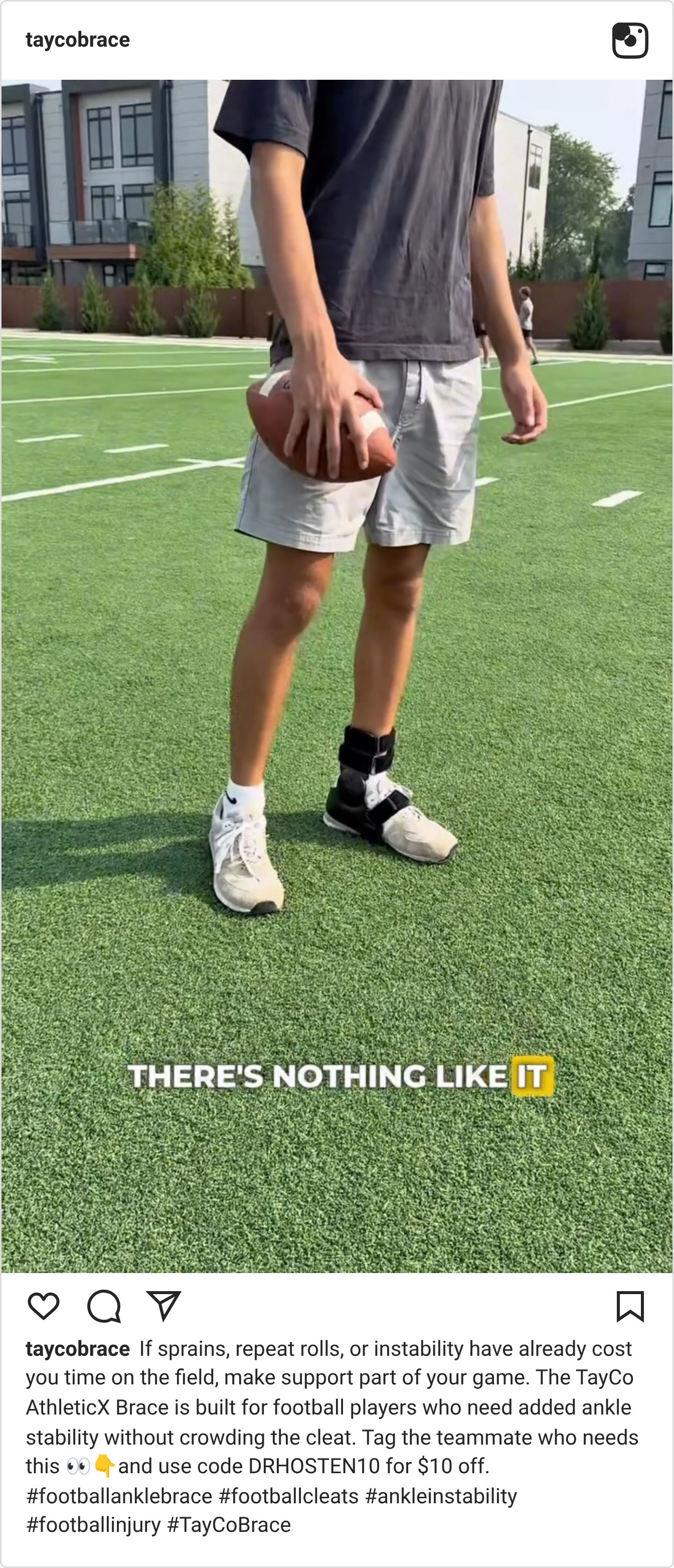
Gavin is a lawyer by trade who runs the business side of TayCo, an external ankle brace now showing up on NFL and college sidelines. However, while the product is showing up on the biggest stages in the world, it didn’t start with a business plan. Instead, an athletic trainer at Notre Dame spotted a problem up close, built his own fix, and word of mouth did the rest.
Today, we'll cover how that invention became a company, what makes it different from a traditional brace, and how a product built for football ended up helping everyday patients too.
Mike wasn’t inventing something to start a business. Mike was inventing something to solve a problem.
How TayCo Got Here
The spark: Mike Bean, the longtime athletic trainer for Notre Dame football, notices a paratrooper entering the stadium wearing an external device outside his shoe, almost like a splint with two bars running down the leg. He wonders what would happen if he extended that down to a foot plate and added a hinge.
The problem he was solving: With a traditional inside-the-shoe brace, a player who goes down has to come off the field, take the shoe off, get evaluated, and have a brace put on. By then the ankle has swollen, so they need a shoe a couple of sizes bigger, and they may be uncomfortable enough to miss an entire quarter. With this design, you can spat it on and the player might only miss one play.
Prototyping: Mike works with Shur Step, a South Bend orthotics manufacturer that mostly makes orthotics for children. They use vacuum-formed plastic to prototype, test, and iterate. TayCo still works with them on its custom devices.
Around 2016: The first brace sees its first live game action. A player who couldn’t plant or push off in a traditional brace tries the new one in practice, then comes back to the sideline and says it’s awesome: he could plant, push off, and move with stability.
Word of mouth: Notre Dame’s opponents, athletic trainers connected to Mike, and people at athletic training conventions start asking about it. At first, TayCo is making custom braces one at a time. A company forms to keep up with the demand.
The wrinkle: Because Mike invented it while working at Notre Dame, the university actually owns the original patent. TayCo negotiated its license with the university, not with Mike directly. Gavin says Notre Dame has been a tremendous partner.
The name: TayCo comes from Taylor, Courtney, and Colleen, Mike’s daughters and wife.
Today: Mike is still a full-time athletic trainer for Notre Dame football, and he sits on the board and gives feedback regularly.
The Big Idea: The Best Products Don’t Need a Pitch
Jake put it best after the interview: TayCo never really did any “selling.”
An athletic trainer made something, told another athletic trainer, that person asked for one, and it spread until a business was necessary to keep up with demand nobody planned for.
We’ve seen this pattern with other guests, like Allen Iverson’s arm sleeve or the NBA’s whistle timer device: they were created by people who understood a problem so intimately that their solution was undeniable.
My note: I don’t know if there’s a clean lesson here. But it made me think about the inverse. When you have a good idea, you can usually tell. And when you don’t, you should probably be able to tell too.
If you’re trying to convince people a piece of content is great, and you’re not seeing any positive signals, maybe your ego is wrapped up in it more than the content deserves. Here, the problem was real, and the fix was so obvious that nobody needed convincing.
5 Tactical Takeaways
Solve your own problem first. Mike wasn’t trying to start a business. He built a fix for something he saw on the sideline every Saturday, and that’s exactly why it resonated.
Borrow from an adjacent field. The idea came from a paratrooper’s external splint. Inspiration for your category may be sitting in a completely different one.
Iterate cheap before you scale expensive. TayCo went from custom casts, to vacuum-formed molds (cheap to change, expensive per unit), to injection molding (expensive molds, cheap per brace). They only committed to the costly stage once the design was proven.
Know who owns your idea. Because Mike invented the brace while employed by Notre Dame, the university owned the patent. Anyone creating something inside an employer, school, or institution should check the policy first.
Seed a tight-knit community. Athletic trainers talk to each other at conventions and across opposing sidelines. Starting where word of mouth travels fast gave the product a built-in distribution channel.
Why It Matters
Mike’s story is a good reminder that some of the best businesses start without a business plan.
A person who sees a problem every day, builds something to fix it, and shares it with the people who understand the problem best can end up with a company almost by accident. Gavin’s role is a nice complement: he says he’s never had a creative idea of his own, but he loves bringing someone else’s to market.
Every inventor needs someone like that. And for the rest of us, sometimes the best marketing strategy is a solution so obviously better that people just start asking for it.
📩 And don’t forget: Bottom of the Ninth is back this Friday with the top three stories in sports and business from the week.
See you then,
Tyler & Jake
