
In partnership with


Happy Wednesday,
For many of us in sports media, broadcasting used to be the finish line.
Now it’s just one lane.
This week, I sat down with Max Browne:
ACC Network color analyst
Former 5-star USC quarterback
Content creator
However, what makes Max so interesting isn’t just that he’s doing both broadcasting and content; it’s how clearly he understands the tradeoffs between control, stability, and long-term leverage.
This conversation turned into a real look at what it takes to build a career in sports media today, especially if you didn’t come in with a Hall of Fame playing résumé.

The best marketing ideas come from marketers who live it.
That’s what this newsletter delivers.
The Marketing Millennials is a look inside what’s working right now for other marketers. No theory. No fluff. Just real insights and ideas you can actually use—from marketers who’ve been there, done that, and are sharing the playbook.
Every newsletter is written by Daniel Murray, a marketer obsessed with what goes into great marketing. Expect fresh takes, hot topics, and the kind of stuff you’ll want to steal for your next campaign.
Because marketing shouldn’t feel like guesswork. And you shouldn’t have to dig for the good stuff.
5 Takeaways From My Conversation With Max Browne

1. He still introduces himself as a “broadcaster”
Max was honest about how he introduces himself (and why):
“I lead with the broadcasting. It’s probably because I’m aware of the negative connotation that content and social media still has in certain rooms.”
Even though most people recognize him from his videos, he’s careful about how he frames his work depending on context. He described it less as insecurity and more as understanding the room.
That tension shows up everywhere for creators who operate in traditional industries. The work might be legitimate, but the perception hasn’t fully caught up yet.
2. Every creator goes through the “that’s cute” phase
Max put words to a stage almost every creator recognizes, “Early on, there’s this tone people have where it’s like, ‘That’s cute. I saw your little video.’ That’s the hardest phase.”
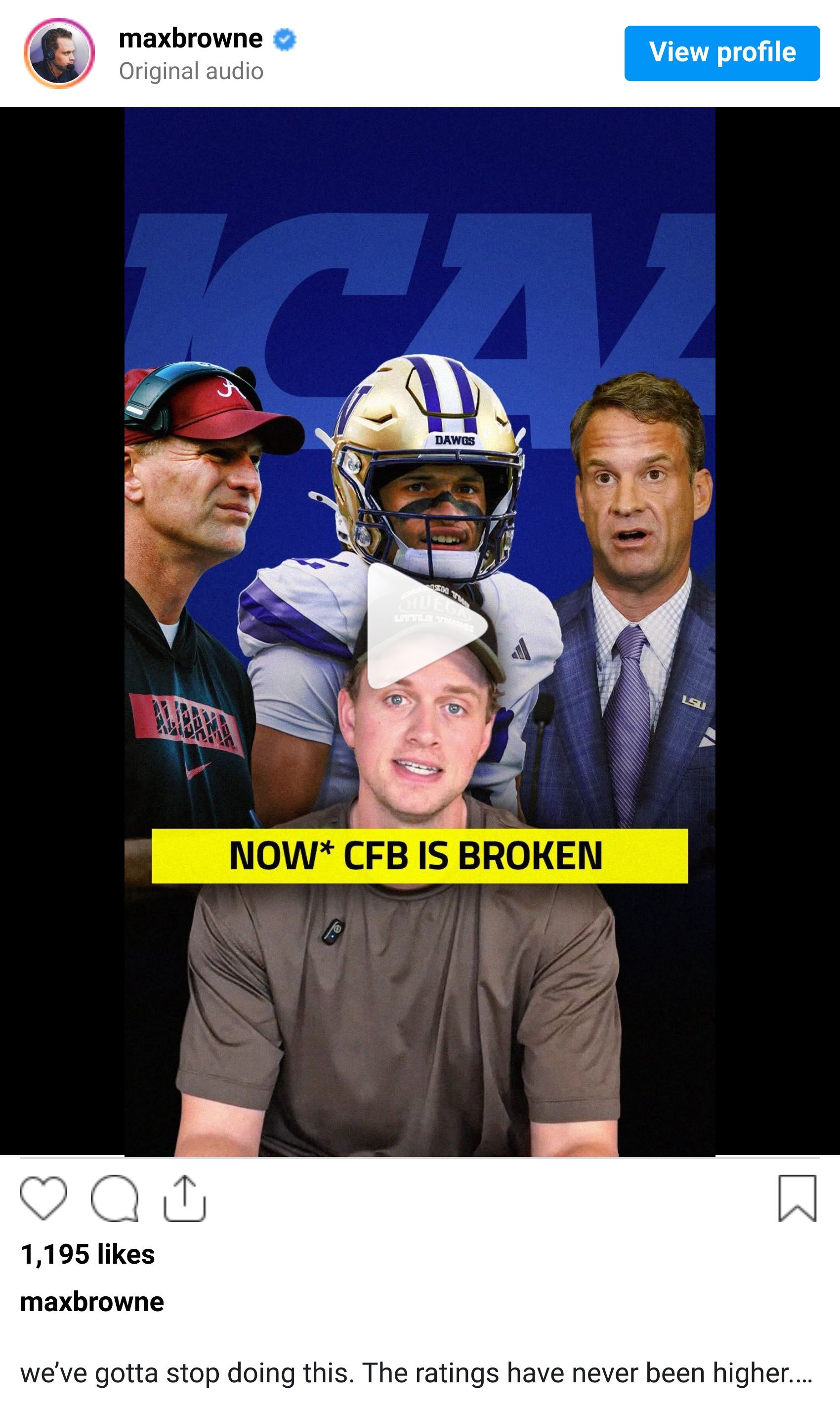
You’re putting real effort into the work, but there’s no external proof yet. No visible scale. No obvious paycheck. Just enough traction to invite skepticism.
Max pointed out that once the proof of concept is in place, those conversations change quickly. Until then, it’s mostly about sticking it out.
3. Content was never the side project; it was the wedge.
Max didn’t use content to chase virality, instead he used it to create leverage.
“The advice I got early was: it’s 2018. You don’t need a network to take a chance on you. You can open up your phone and your camera.”

His YouTube work became a tangible asset he could present to decision-makers. Instead of waiting on networks, he showed them what he could already do.
That approach helped him move from radio to Pac-12 Network to ACC Network. The throughline was not a single big break. It was a steady progression powered by “owned work.”
4. Content feels more stable than broadcasting
This part surprised me.
Max said content actually feels safer than the booth, “Broadcasting is cutthroat. The second someone like Josh Allen retires, they can skip the line I’ve been grinding in for years.”
With content, Max controls the platform, the audience, and the distribution. He’s even turned down higher-paying deals to keep ownership of his views.
“I’ve taken less money to make sure I control the content long-term.”
That mindset upends the traditional idea of stability.
5. Being “good at content” mostly comes down to effort
When I asked why more broadcasters struggle with digital, Max didn’t overthink it.
“It takes work. Blocking out 40 minutes after a coaches meeting to film a video is something most people just don’t want to do.”

He also pointed out a bigger truth: for many broadcasters, this is a backup career. For him, it isn’t.
That difference shows up in how seriously people take building an audience, learning platforms, and staying uncomfortable.
Why It Matters
Sports media careers are quietly changing.
Networks, agents, and leagues still treat digital and linear as separate lanes, but creators like Max are building in the overlap. He’s betting that in five to ten years, being fluent in TikTok, YouTube, and short-form storytelling won’t be optional for on-air talent.
The broader takeaway is simple: careers compound faster when you own part of the distribution.
Broadcasting still matters (so does content), but those who understand how they reinforce each other will have greater control when the industry shifts again.
📩 And don’t forget: Bottom of the Ninth is back this Friday with the top three stories in sports and business from the week.
See you then,
Tyler & Jake