Sponsored by


I want to apologize in advance for the amount of pee-related content in today’s newsletter.
A little peek into my process: I typically spend all morning on Tuesdays, Wednesdays, and Thursdays reading, researching, and writing. Usually, I have a sense of when each story will come out, but sometimes they get moved around when something more pressing comes across my desk. I guess I forgot to double-check this week that I wasn’t already doing a story about pee. Oh well.
In today’s newsletter:
🗞 The Big Story: Sports Newest Tech Frontier? Urinals
📉 Biggest Loser: Why Do Referees Have Jersey Numbers?
🏆 Winner’s Circle: University of Michigan Wins the Inaugural “Piss Off”
Your K-Cup Has Been Sitting in a Warehouse for Months

That grocery store pod? It was roasted long before it hit the shelf. Coffee starts losing flavor within weeks of roasting — which is why your morning cup tastes flat, no matter how nice your machine is.
Angelino's does it differently. A third-generation roaster in Los Angeles, they roast, grind, and seal every pod in-house for peak freshness, then ship it to your door within days of roasting. The difference is the first thing you'll notice: real aroma, real flavor, no bitterness.
Mix and match from 50+ specialty coffees, teas, and flavored blends — all Keurig®-compatible — and save more with every box you add, up to 34% off at 12+. Order once whenever you're running low, or subscribe for an extra 5% if that's easier. Entirely up to you.
New customers get 15% off their first order — applied automatically, no code needed.
🗞️ Sports Newest Tech Frontier? Urinals

This is the most high-tech urinal ever created, and it could help solve one of sports' oldest problems.
Hydrate or Die: It’s no secret that proper hydration is one of the most important factors in an athlete’s performance and recovery. Still, a recent review of 24 studies found that an estimated 66.2% of professional athletes were either under- or over-hydrated, which is a serious risk to on-field performance.
That’s why, for the past four years, a company out of Spain has been developing a “Smart Urinal.” But what does it actually do?
Lead Time: Historically, tracking an athlete’s hydration levels has been tedious and ineffective. It's extremely time-consuming for athletic trainers, and because hydration levels can change so quickly, by the time athletes get their results back, they’re typically outdated.
That’s why dozens of professional football clubs across England, Spain, France and Monaco have started investing in “S-Urnials.”
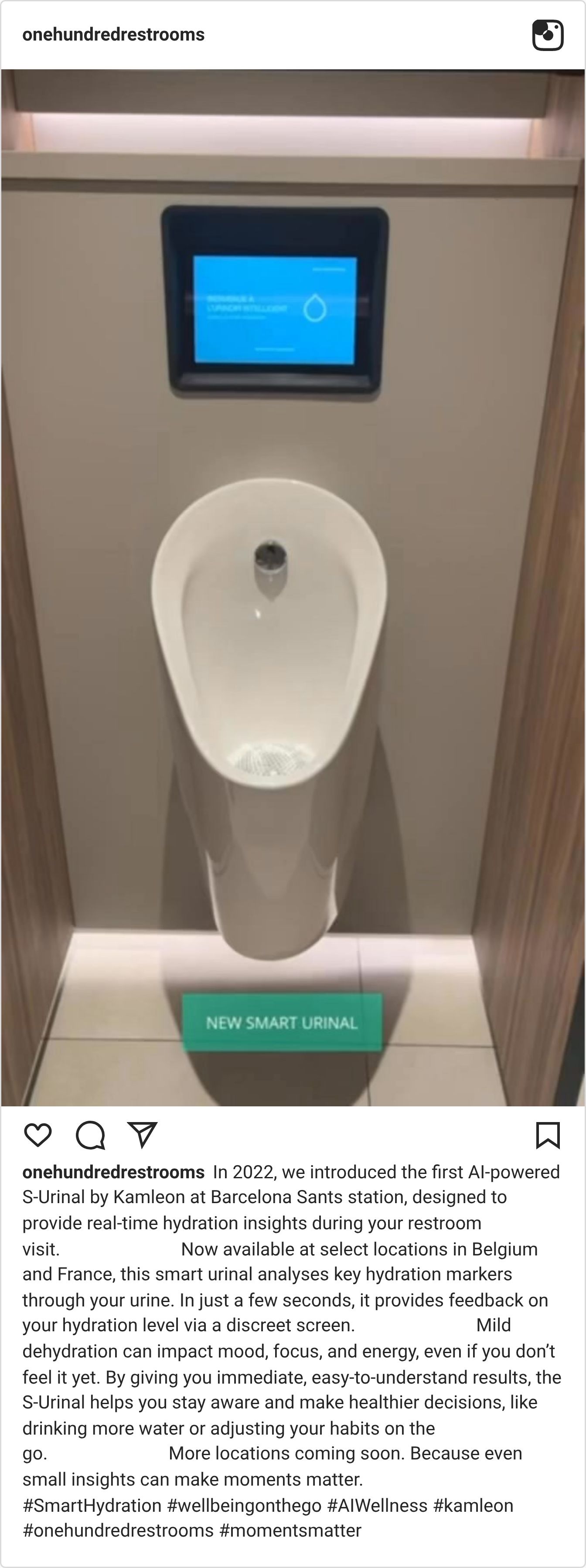
Fluid Flagging: Each one comes with a touchscreen, on which a player can choose to urinate “anonymously” or in “identification mode.” If they choose the latter, the system collects and compares their urine’s:
Color
Colume
Electrolyte concentration
Players then receive an immediate hydration score out of 100, and the rest of the information goes directly to the team’s training staff, who can quickly develop a plan to address any problems.
To date, five teams in the Premier League, three more in Spain, and several others across Europe have already adopted this technology as part of recent multimillion-dollar facility upgrades. Some even use the urinals to incentivize in-house competitions to see which players score the most or use the technology the most.
Teams really will do anything to gain an edge.
📉 Why Do Referees Have Jersey Numbers?

Why do referees have jersey numbers?
Even though you might assume it’s just a way to identify them, the reason behind each one is actually more complicated than that.
Origin: NFL officials have worn numbers since 1942; back then, they were assigned numbers based on their job. The primary officials at each position had numbers ending in 0, while their backups had numbers ending in 1.
Referee: Primary 10, Back-Up 11
Umpire: Primary 20, Back-Up 21
Linesman: Primary 30, Back-Up 31
Line Judge: Primary 40, Back-Up 41
Field Judge: Primary 50, Back-Up 51
Back Judge: Primary 60, Back-Up 61
However, that all changed in 1979, when the NFL attempted to streamline the numbering process by assigning each official the same number based on their position. But this experiment was short-lived, after players, coaches, fans, and even other officials realized it was too difficult to tell everyone apart.
So, starting in 1982, each official could choose their own number (with a few notable exceptions).

Jerome Boger (left) Johnny Grier (right)
Tradition: Like players, officials choose their numbers based on a wide array of factors, including personal significance, family lineage, or even availability. For example, when Jerome Boger joined the NFL in 2004, he asked the NFL’s first black referee, Johnny Grier, if he could wear his number in his honor when he retired. Grier agreed, and after retiring two years later, Boger has worn number 23 ever since.
Then you have examples of families like the Colemans, who have kept the same number between father and son since 1989, the longest such streak in league history.
Options: Since 1942, every number from 1 to 142 has been worn at some point, although the higher numbers are typically seen as “less desirable.”

Al Riveron
Still, even today, some numbers are off-limits. For example, the league didn’t assign number 57 until its former owner, Al Riveron, felt there was an official deserving - which happened in 2020. For a long time, numbers 1 and 13 were also kept on the shelf for a similar reason. Meanwhile, number 69 remains off limits for… other reasons.
Who knew officials cared so much about their jersey numbers?
🏆 University of Michigan Wins the Inaugural “Piss Off”

The University of Michigan just won its most important game of the year, but it has nothing to do with football; let me explain.
Last week, you might have seen headlines going into the Michigan-Michigan State game about something called a “Piss Off.” But while this competition might sound like a joke, its results were a massive step toward solving one of society’s most under-discussed problems.
Farmer’s Gold: Even though commercial fertilizer is widely considered to be one of the most important inventions in human history, enabling us to feed billions of people, the process of making it uses roughly 1-2% of the world’s energy supply and is responsible for emitting a similar share of CO2 pollution.
Luckily, the three ingredients in most synthetic fertilizers:
Nitrogen
Phosphorus
Potassium
Can all be found in our urine; the only question is: how do we get it out?
Well, that’s the exact problem scientists at the University of Michigan just tried to solve with their first-ever “Piss Off.”
Collection Process: The goal of this event was simple: they wanted to see if nitrogen, phosphorus, and potassium could be extracted from thousands of people’s pee. At a basic level, they do this by collecting urine from waterless urinals into large tanks. It then gets pasteurized, filtered, and put through a patented freeze-thawing process to remove most of the water. Then, after isolating the three key nutrients, you’re left with fertilizer pellets.

Researchers collecting urine from waterless urniles
According to one study, it would take as little as 4% of all the urine flushed by staff and students at the University of Michigan to replace all the fertilizer the school currently purchases from outside sources.
To be clear, urine-based fertilizer is still restricted to water-fed crops, but it’s already widely used across the university for things like lawns and flowerbeds.
Obstacles: Still, the biggest problem in this whole process is separating the urine from everything else. That’s why these same scientists have been working on a new kind of “split bowl toilet” that can collect urine and other waste separately to make the process easier.
But until those can be rolled out across the school, researchers decided to set up two port-a-potties, with 5 waterless urinals each, outside the Michigan-Michigan State game to test their process at scale.
In total, they collected 237 gallons of urine from an estimated 3,000 people, with Michigan fans winning the inaugural “Piss Off” 137 gallons to 100. And even though that will only produce enough fertilizer for a few residential lawns, the project’s lead scientist said that the competition will go a long way in studying the future of fertilizer.
⏱️ In Other News
When you refer new readers to the Bottom of the Ninth, you win exclusive prizes.

➡️ Here is your unique link to share: {{rp_refer_url}}
You’re currently at {{rp_num_referrals}}. That’s only {{rp_num_referrals_until_next_milestone}} away from receiving {{rp_next_milestone_name}}!
*Please do not use fake email addresses — they will not qualify as referrals. Thank you!
👋🏻 Happy Friday!
Sometimes, in order to learn a lesson, it has to slap you in the face.