


I’ve taken a new approach to sports fandom this year. Instead of being worried if the Packers are winning the Super Bowl, or if the Gophers are beating the Badgers at the end of the eason, I’m strictly week-to-week.
Maybe I’ve been incepted by the coach-speak of guys like PJ Fleck, but I’ve decided to enjoy it when my team wins one week, I’m simply going to enjoy it (crazy concept, I now), and I’m not going to worry about the impending dread that their season might not end up the way I want it to.
In today’s newsletter:
🗞 The Big Story: Was Hosting The World Cup Actually Worth It?
📉 Biggest Loser: What’s This Helmet Cover College Players Are Wearing?
🏆 Winner’s Circle: The Cal Bears Are Making CFB History (Good or Bad)
Daily news for curious minds.
Be the smartest person in the room. 1440 navigates 100+ sources to deliver a comprehensive, unbiased news roundup — politics, business, culture, and more — in a quick, 5-minute read. Completely free, completely factual.
🗞️ Was Hosting The World Cup Worth It?

Was hosting the World Cup actually worth it?
The short answer is no, but the real answer is actually a lot more complicated than you might think.
Buy-In: Even though all 16 host cities had to spend a reported $100 to $150 million each to host this summer’s World Cup, much of which came in the form of taxpayer money, we were promised that those upfront costs would be more than paid back thanks to a boom in tourism spending and taxes collected over the course of the tournament.
However, now that we’re several months removed from the event, we actually have all those numbers, and they tell a much different story.
Economic Impact: Just look at Seattle, for example. After hosting 6 World Cup matches this summer, the local tourism marketing organization, Visit Seattle, announced that the tournament drove $889 million in total economic impact for the city and surrounding county, which included $109 million in state and local tax revenue.

For context, that's $43 million more in total economic impact than the organization estimated back in March. So I guess hosting the World Cup was worth it, right?
Well, when you dig into the numbers a little deeper, you’ll see that overall travel to the city actually dropped by 0.01% as compared to the same time last year. Hotel occupancy rates also fell.
So what happened?
Worth It? Based on the travel and hotel data, it seems the World Cup squeezed out many other tourists who would have come to Seattle this summer anyway. In fact, based on 2025 economic impact reports, the World Cup increased overall economic activity this summer by only around 20%.

To me, this suggests the tournament didn’t attract more people to the region so much as it attracted different people.
It’s also worth noting that while Visit Seattle will brag about the $109 million in tax revenue the World Cup brought to the state, local estimates suggest state and local governments spent around $120 million to prepare for the event.
Now, event organizers will tell you that even if the economics don’t line up, this summer still served as a great marketing opportunity for the region. However, my argument is this: if millions of people would have come to your city anyway, why spend all that public money in the first place?
📉 What’s This Helmet Cover College Players Are Wearing?

What are these covers that college football players are wearing on their helmets?
It turns out, they might actually be safer than Guardian Caps, but not for the reason you might think.
Misleading Study: Even though Guardian Caps have become a staple across all levels of football, with the NFL even touting a 50% drop in concussions among players who wore them, recent evidence suggests those numbers might not be entirely accurate.

In fact, when the NFL reviewed that initial “50% reduction” claim a few years later, they found that “there was no longer a significant relationship between Guardian Cap use” and concussions.
So why do players still wear them?
The Numbers: Aside from requirements in the NFL and across many colleges, a Virginia Tech study did find a meaningful reduction in concussion risk when wearing a Guardian Cap by up to 63%.
But there’s a catch…

Control (left), Add-On (center), Double Add-On (right)
See, the version this Virginia Tech lab studied is called the “NXT,” which is only available for pro and college players. Instead, the consumer model that most athletes have access to is called the “XT,” which, according to that same study, only reduces concussion risk by up to 22%.
Third Way: Luckily, this Virginia Tech lab tested a third helmet cover that reduced concussion risk by up to 52%, and you’ve probably already seen it without even realizing it.
This is called the SAFR Helmet Cover. Instead of bulky foam padding, these are made from a denser type of polyurethane foam that absorbs and dissipates impact energy.
However, unlike the Guardian Cap, the same version you see college football players wearing on Saturdays is the exact same product you can buy directly from their website.
Now, to be fair to Guardian, a SAFR Helmet Cover can cost up to $90 more, but I’d imagine, given how they look, it might be worth it for some people.
🏆 The Cal Bears Are Making CFB History (Good or Bad)

The Cal Bears are about to attempt something no other team has ever tried, and it’s either going to completely blow up in their faces or change college football forever.
Rocky Start: After joining the ACC in 2024, Cal’s sports spending has been forced to increase drastically to keep up with Power Four competition, resulting in the school’s athletic department reporting a $24 million loss last year.
To close this gap, Cal sold a jersey patch sponsorship across all 30 varsity sports to an AI call center company called Dialpad in a deal worth $3.2 million per year over the next 5 years, or up to $16 million total.

But what about the rest of the $24 million deficit?
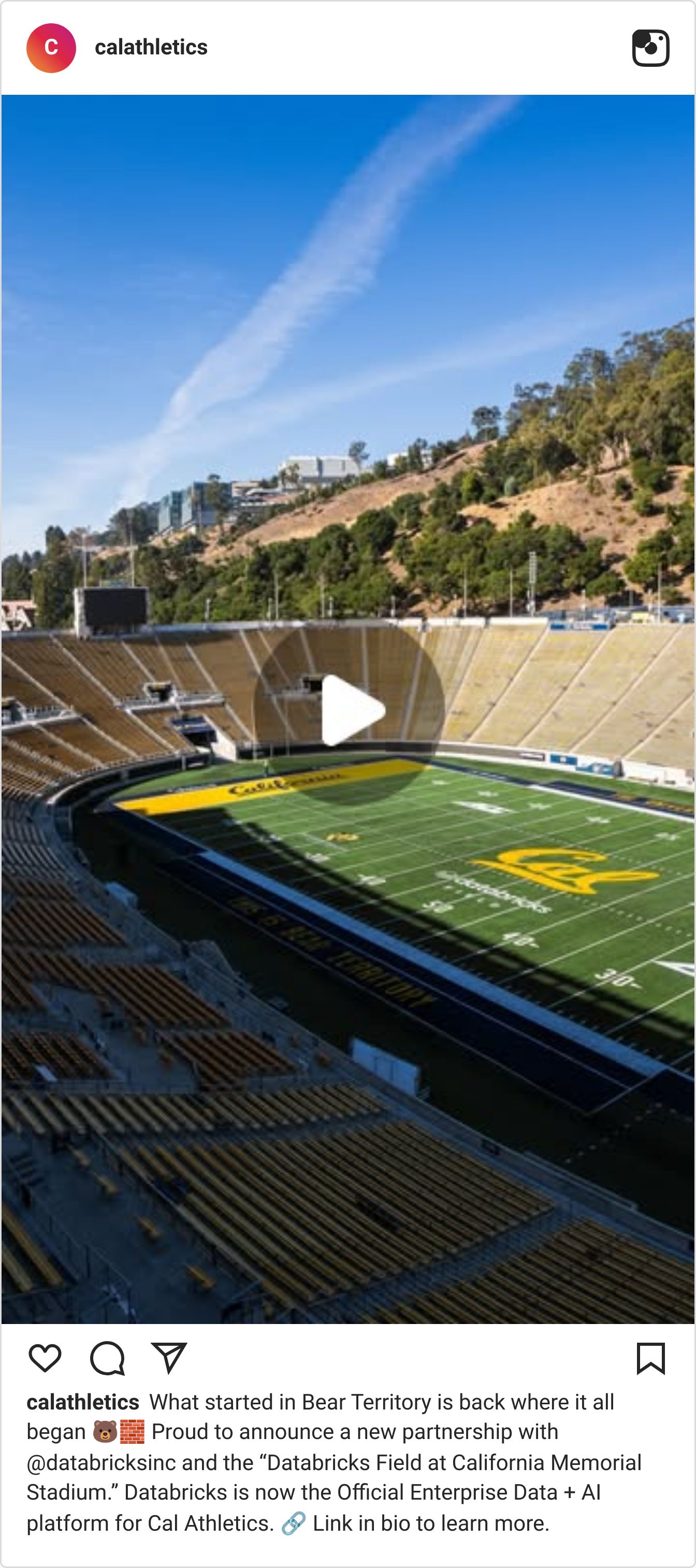
New Name: To address that, the Cal Bears signed a midseason stadium naming-rights deal with another AI company called Databricks; however, it’s not the timing or the type of company that makes this deal so unique.
Instead, as part of this 10-year, $22.8 million deal, in which Databricks will put its logo on Cal’s helmets and at midfield, and the university will receive cash as well as equity in the company.
History Maker: Cal has described the structure of this deal as “historic” both in the context of college sports and as the university’s largest sponsorship deal ever; still, it could completely blow up in their faces.
That’s because, as recently as 2021, Cal made a similar “landmark” announcement with FTX, which agreed to pay the school $17.5 million over 10 years entirely in cryptocurrency for the naming rights to their football stadium. However, just 450 days after signing that deal, Cal was forced to terminate it after FTX’s founder was arrested for fraud and the company’s value dropped to $0.
Now, the benefit of taking equity in an AI company like Databricks instead of just getting cash is obvious: if the company, which has reported revenues of over $7 billion per year and is valued at $190 billion, ever IPOs on the stock market, Cal’s stake could increase in value by 5-10x.
And if that happens, then don’t be surprised to see more struggling athletic departments make the same bet in the future.
⏱️ In Other News
When you refer new readers to the Bottom of the Ninth, you win exclusive prizes.

➡️ Here is your unique link to share: {{rp_refer_url}}
You’re currently at {{rp_num_referrals}}. That’s only {{rp_num_referrals_until_next_milestone}} away from receiving {{rp_next_milestone_name}}!
*Please do not use fake email addresses — they will not qualify as referrals. Thank you!
👋🏻 Happy Friday!
I’ve gotten myself into a bit of a pickle. Before the Gophers played the Huskies two weeks ago, I took Washington -10.5. My logic was, Minnesota never seems to play good teams close. They either upset them, or get blown out. So, as an emotional hedge for the potential blowout, I decided to toss down $10 on the Huskies.
But then the Gophers won, and after a week of unprecidented national media attention, they entered their game against Michigan as 5.5 point underdogs. I figured, surely the hype has gotten to be too much. There’s no way the Gophers don’t lose by at least a touchdown. So I once again took their opponent at -5.5 only to be proven wrong.
So here’s my pickle: it seems like in order for them to win, I need to keep betting against my favorite college team every week. Luckily, my unit size is relativley modest and I’ve decided it’s a small price to pay for beating Iowa.