
In partnership with


It’s a golf newsletter today, folks. I promise there will be no other newsletter this year that’s 100% golf, but it’s the Masters. Let’s enjoy the pomp and circumstance together.
In today’s newsletter:
🗞 The Big Story: Augusta’s Annuity: How to Make $25K/Yr For Life
📉 Biggest Loser: Why Does the Masters’ Winner Get a Green Jacket?
🏆 Winner’s Circle: The Tech Solving Augusta’s 12th Hole
Smart starts here.

You don't have to read everything — just the right thing. 1440's daily newsletter distills the day's biggest stories from 100+ sources into one quick, 5-minute read. It's the fastest way to stay sharp, sound informed, and actually understand what's happening in the world. Join 4.5 million readers who start their day the smart way.
🗞️ Augusta’s Annuity: How to Make $25K/Yr For Life

The easiest way to make $25,000 per year for the rest of your life is by winning the Masters once. Let’s break it down.
Lifetime Exemption: This year, 91 players have been invited to compete at Augusta National for a reported $21 million purse, with the winner earning $5 million.
But that’s not even close to the most valuable prize of the weekend.
That’s because (unlike every other major) the winner of the Masters will earn a lifetime exemption to the tournament. Meaning, even if they never play in another professional golf event again, they’ll always qualify for the Masters, which presents an interesting problem.
Old Heads: This year, about 20% of the field is made up of previous Masters winners, including 66-year-old Fred Couples and 63-year-old Vijay Singh. However, not that long ago, you had guys utilizing their lifetime exemption to play well into their late-70s.
For example, after winning the 1957 Masters, Doug Ford wanted to become the first player to play in the tournament 50 times. But after last making the cut in 1971 at the age of 48, Doug went on to play for the next 30 years:
21 missed cuts
9 withdrawls
That’s why, after his 49th appearance in 2001, when the 78-year-old Ford only made it through the first 9-holes before withdrawing, Augusta National announced that it would ask previous champions to stop playing after 65.

Left: Doug Ford winning the Masters, 1957. Right: Doug Ford playing in the Masters, 1985
However, this rule change didn’t sit well with legends like Arnold Palmer and Jack Nicklaus, who still wanted to play in the tournament. So, instead of a blanket rule change, the club was selective about whom it asked to stop playing, allowing the most popular champions to stop on their own time.
Augusta Annunity: To this day, Nicklaus is still the oldest player to win the Masters, at 46, but even missing the cut at Augusta comes with a $25,000 check.
Meaning, if you win the Masters once at 25 years old, and simply play in the tournament for the next 40 years, at worst, you’d end your career making $1,000,000 just by playing at Augusta National once per year.
Hell, I’d pay that much just to play the course once in my life.
📉 Why Does the Masters’ Winner Get a Green Jacket?

Why does the winner of the Masters get a green jacket?
Well, it’s actually because of one of the most hated traditions in sports that no one seems to know anything about.
Seeing Red: Three years before Augusta National ever even opened, an amateur American golfer named Bobby Jones was playing a round at the Royal Liverpool Golf Club ahead of the 1930 British Open Championship when something caught his eye:
Members of this exclusive club all wore the same red blazer.
Now, as the story goes, Jones wouldn’t stop asking one member in particular about his jacket, so as a way to appease him, this member offered to give it to Jones if he won the upcoming Open Championship. Obviously, Jones did, collecting the 11th of his 13 career major victories in the process and returned to the U.S. with a trophy and red blazer in hand.

Royal Liverpool Golf Club red blazer & Bobby Jones after winning the 1930 Open Championship
However, later that same year, Jones shocked the sports world when he retired at 28 to open a golf course in Augusta, Georgia. But it was here that one of golf’s best traditions would be born, even if not everyone was happy about it.
Building a Legacy: Even though Augusta National held the first Masters in 1934, it wasn’t until 1937 that Jones adopted the idea of having his club’s members wear green jackets to make themselves more identifiable to patrons during the tournament. Then, it wasn’t until 12 years after that for the first Masters’ champion to get a green jacket of his own, with Sam Snead in 1949.
All of the previous champions were retroactively given a jacket at that point, too.

Augusta National’s members and Sam Snead with his jacket
Material Changes: Even though the green jacket has since become one of the most iconic awards in sports, at the time, it wasn’t well-received, with members complaining that it was too thick and uncomfortable in the warm Georgia climate.
So, in 1967, Augusta National changed its manufacturer to Hamilton Tailoring Company in Cincinnati, which began using a tropical-weight wool sourced less than 100 miles from the course.
Evidently, this change made enough of a difference to maintain the legacy of the green jacket for the next 60 years.
🏆 The Tech Solving Augusta’s 12th Hole

One of the toughest holes in all of golf just got a little easier this week, and it’s all thanks to this high-tech device.
Golden Bell: Augusta National’s 12th hole is a 155-yard par 3 that boasts an all-time scoring average of 3.29, making it the second-toughest hole on the entire course, and even more challenging in relation to par than TPC Sawgrass’s iconic island-green 17.
But what makes it so difficult?
Well, the 12th green at Augusta is actually the lowest point on the entire course. When you couple that with the towering trees that sit several hundred feet above the hole, you end up with what 1949 Masters’ Champion Sam Snead called a “whirlpool” where the wind swirls unpredictably above the flag.

Augusta National’s 12th Hole
Now, up until this year, you might see golfers throwing up snippets of grass or watching the flag on the nearby 11th green to get a sense for the wind before teeing off on 12, but this year, a select number of caddies are using a new piece of technology to more accurately predict the wind than ever before.
Wind Visualization: Pictured above is an Anemometer Wind Vane. It’s used by a company called Weather Applied Metrics to create visual models of how wind affects a golf ball's flight path.
Now, it’s possible that you’ve already seen WAM’s wind visualizations when watching an MLB broadcast, but at this year’s Masters, the data collected on the course will actually be provided before and after each round directly to “at least one unnamed” golfer “and several caddies.” According to the Sports Business Journal, WAM’s system delivers wind data “from a player’s ankles to the highest apex” of their shot.
Even though we don’t know exactly who will be relying on it this week, I’m sure that if it’s helpful, it won’t be long before we hear about every golfer using it.
⏱️ In Other News
When you refer new readers to the Bottom of the Ninth, you win exclusive prizes.

➡️ Here is your unique link to share: {{rp_refer_url}}
You’re currently at {{rp_num_referrals}}. That’s only {{rp_num_referrals_until_next_milestone}} away from receiving {{rp_next_milestone_name}}!
*Please do not use fake email addresses — they will not qualify as referrals. Thank you!
👋🏻 Happy Friday!
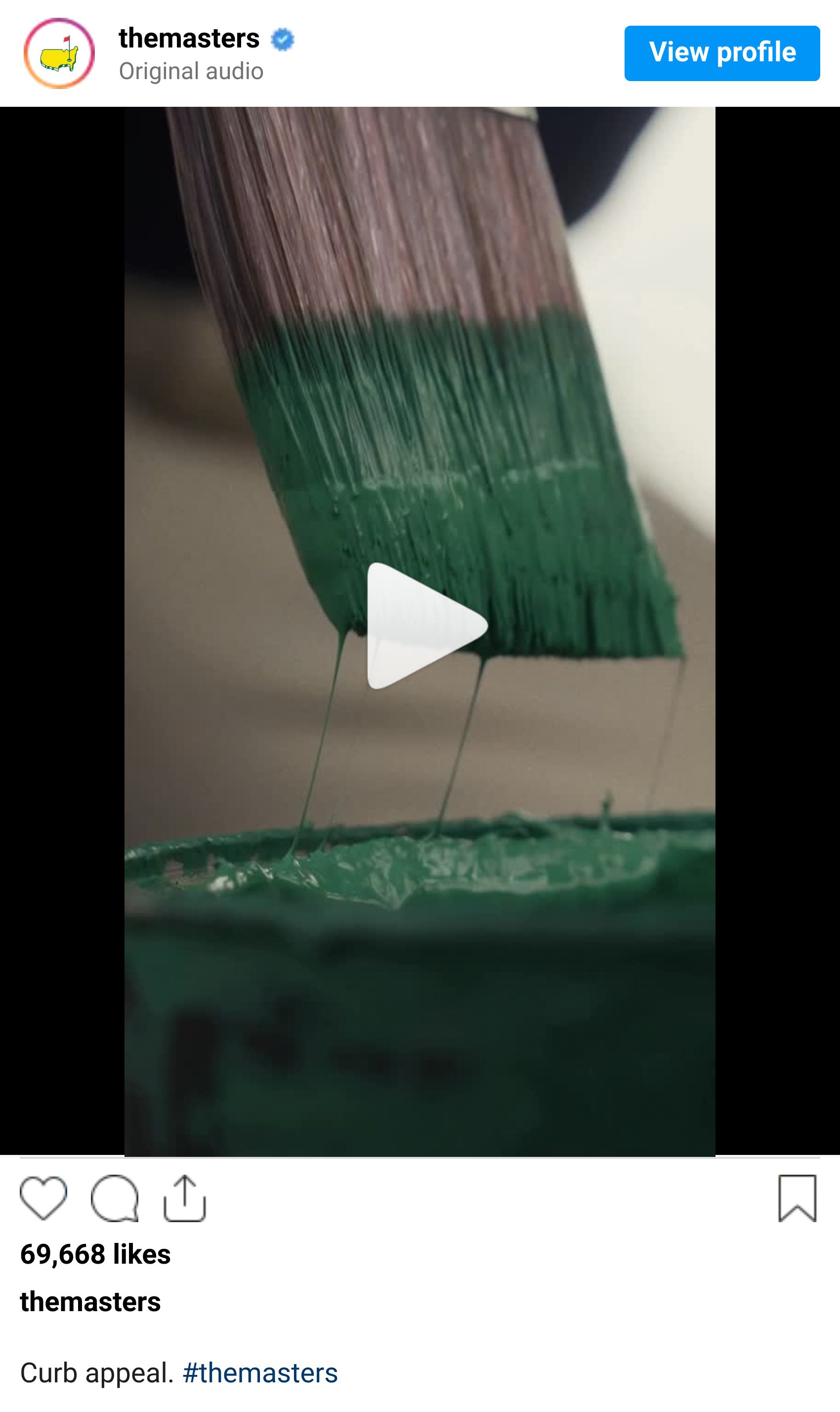
If any video captured the vibe of the Masters, it would be this one:
FWIW, I have tickets on Bryson, Patrick Reed, and Akshay Bhatia this weekend.