


Happy Wednesday,
I recently flew to New York City for a panel with The Athletic’s commercial team to talk about how creators actually make money from short-form content, and the conversation has been rattling around in my head ever since.
So this week, Jake and I spent about an hour working through it:
How brands and creators should think about monetizing short-form
What makes a creator “easy to work with” (from both sides)
Why chasing the biggest payout isn’t always the smartest move
What we’d do if we had to start from scratch today
+ Much more
A lot of creators think their job is to extract as much value as possible from a brand, as if they’ll never work with that brand again.
What Happened In New York
The setup: I joined a panel with The Athletic’s commercial team, alongside Frank Michael Smith and two people from The Athletic’s video team. The audience was the people who sell ads against The Athletic’s content. They sit in the middle, matching what the writers, producers, and creators make with what brands are asking for.
The question: Frank and I are both full-time creators, and they wanted to know how we make money from short-form. Like a lot of media companies, The Athletic is still figuring out how to make money directly from it.
My honest answer: When the moderator asked why we like working with The Athletic, I said it’s cool to be in the New York Times building, but we work with them because they pay us. Credibility, access, and money are the three things a media brand can offer, and the guaranteed money is something we couldn’t get on a random video. Frank joked afterward that I was a little too honest.
The math: My Athletic videos are basically my own organic videos cross-posted, so the calculation is different from a brand deal like Gillette. A Gillette rate is higher because I wouldn’t make a video about a new razor on my own. And because there are no gatekeepers for distribution anymore, my videos can reach as many people as The Athletic’s, so I don’t necessarily need them to distribute my work.
The tension: A big media brand sells at scale across hundreds of millions of impressions and cares about CPM. Short form has no single understood ad unit, so everything I make for a brand ends up bespoke. That’s a real mismatch.
The Big Idea: Creators Are Conduits
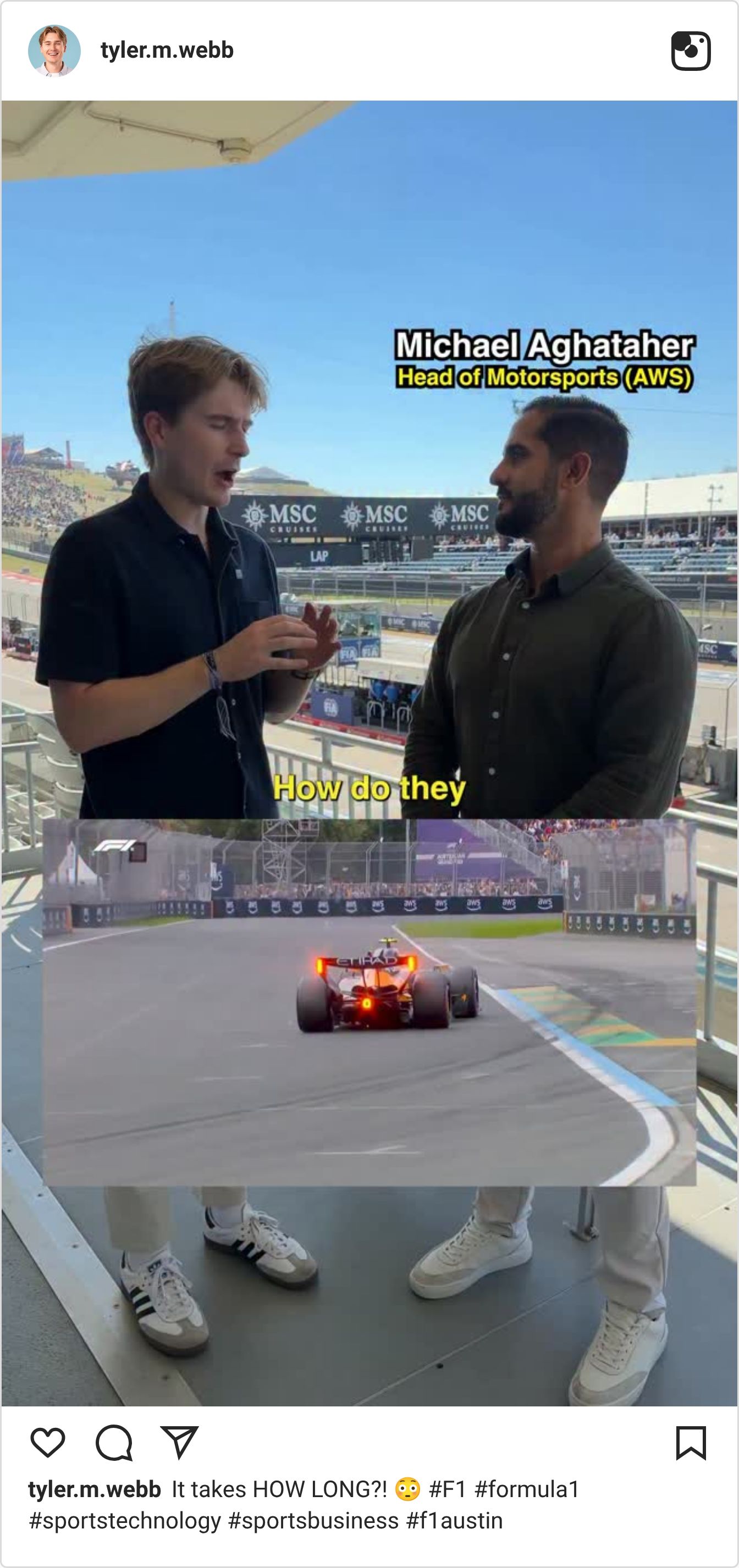
Brands want to show up next to culture people already care about. Amazon Web Services is a major F1 sponsor and powers the broadcast stats, but it’s hard for them to show up organically at an event like that. Bringing a creator down to Austin gives them a way in: I can talk about the technology side of F1 and AWS, and the brand gets talked about the way it wants to be.
The Athletic has the same problem with live sports. As a media company, it doesn’t hold broadcast rights the way ESPN, CBS, Fox, or NBC does. So the content its staff and creators make will never compete with those companies.
But that’s what creators are for.
I see the stuff we make as the “shoulder content” around live sports: what that recovery device an athlete is using on the sideline, why Josh Allen’s eyes are red, why players wear two mouth guards. The Athletic gets into NFL conversations without paying hundreds of millions to license footage. Creators are the conduit between a brand and an audience.
But, it goes wrong when a brand tries to jam a square peg into a round hole (for example, say these 15 talking points in the first five seconds). These days, consumers can sniff out an ad instantly.
5 Tactical Takeaways
Price for the relationship, not the single deal. If a brand will work with you once, you may want to cash in. But if you could earn $10,000 from one deal or $25,000 over a year, the lower per-video rate can be better for both sides. Agencies may avoid creators they can’t afford for twenty videos.
Pitch around tentpole events. At a TikTok webinar, staffers from a few pro teams explained that their budgets are tied to big moments like the NBA All-Star voting or the NFL Draft. Give a team an event to build a story around; that way, it’s easier for them to justify spending. I learned this when a food vendor at Wrigley Field wanted a video of mine to come out on National Hot Dog Day so they could prove ROI internally.
Be easy to work with. Jake can name the five creators he’d call first on any project, even at a premium, and the five he’d never touch. What separates them: responding quickly, taking ownership of the process, good grammar in emails, being brand safe, and delivering files organized in clear folders (a Google Drive link is the bare minimum).
Know how people talk about you. Think about how someone would describe you at a party: “He’s the guy who ____.” Format helps you decide which brands fit and helps a brand picture how to work with you. Most decisions about working with you happen in rooms you’ll never be in.
Ask about guardrails and distribution up front. My first Gillette video was meant to feel organic, and then three months later it had five million views because they put paid spend behind it. I would have made something different had I known. Brands, if you say “full creative freedom,” mean it.
Why It Matters
Permission to get existential?
Jake introduced me to a term during this episode that I’m co-opting for creators. It’s called hylomorphism, a doctrine originating with Aristotle that posits every physical object is a compound of two intrinsic, inseparable principles: body and soul.
Stick with me on this. I think as creators it’s easy to look at the most successful among us and ask, “Why am I not there yet?” When Kylie Jenner gets paid $100,000 for an Instagram story, she’s not exhibiting any unique skill that one of us couldn’t do ourselves, so it’s easy to feel like we’re falling behind.
But in our pursuit of a certain level of financial success (the body), I think we risk losing the soul of our content. I can’t tell you how many creators I see achieve a modicum of success, then start using AI to churn out scripts, or cheap editors to turn around clickbait videos, all in an attempt to “make more money.”
That’s not to say creators shouldn’t try to grow their businesses, but I think sometimes it’s worth stepping back and asking: to what end?
I strongly believe the reward for good work is more work. We’re playing an infinite game that never ends. So don’t race to a finish line that doesn’t exist and lose the “soul” of your content in the process.
📩 And don’t forget: Bottom of the Ninth is back this Friday with the top three stories in sports and business from the week.
See you then,
Tyler & Jake