
Sponsored by


Growing up in Green Bay, WI, the Milwaukee Brewers always seemed to be on TV. However, for most of my life, they were simply background noise, largely irrelevant, even in a house with three boys who grew up playing baseball.
Now, don’t get me wrong, we had our flashes. Still, those one-off seasons with Zack Greinke or CC Sabathia felt like flashes in the pan. Even when the Brewers started having more sustained success, it was always underscored by the implicit assumption that some franchise with more money and better players would send them home in October.
That’s what made this year’s team so fun. The excitement around this group wasn’t fleeting. It was intentionally constructed around a young core with a unique identity and something to prove. The 2026 Milwaukee Brewers were a team with a specific mission and a philosophy, a sort of underdog ethos that made them easy to root for.
So even though the next few months will be spent debating salary caps and deferred money, it’s worth pausing to appreciate this team that, in a lot of ways, was 57 years in the making.
In today’s newsletter:
🗞 The Big Story: The Truth Behind Caleb Williams’ Cleats
📉 Biggest Loser: Did the World Series Just Save Baseball?
🏆 Winner’s Circle: Meet the Trainer Who Reinvented the Ankle Brace
Your K-Cup Has Been Sitting in a Warehouse for Months

That grocery store pod? It was roasted long before it hit the shelf. Coffee starts losing flavor within weeks of roasting — which is why your morning cup tastes flat, no matter how nice your machine is.
Angelino's does it differently. A third-generation roaster in Los Angeles, they roast, grind, and seal every pod in-house for peak freshness, then ship it to your door within days of roasting. The difference is the first thing you'll notice: real aroma, real flavor, no bitterness.
Mix and match from 50+ specialty coffees, teas, and flavored blends — all Keurig®-compatible — and save more with every box you add, up to 34% off at 12+. Order once whenever you're running low, or subscribe for an extra 5% if that's easier. Entirely up to you.
New customers get 15% off their first order — applied automatically, no code needed.
🗞️ The Truth Behind Caleb Williams’ Cleats

What the heck is going on with Caleb Williams’ cleats?
Well, even though you've probably already seen that he was fined over $11,000 for the pair he wore last week, the reason is actually more complicated than you might think.
Nothing New: Even though Caleb just made headlines this week for wearing a brand of “smart cleats” called Caddix, he’s actually been wearing them all season.
In fact, as early as this summer, when he was photographed for the Madden cover, you can clearly see he was wearing Caddix cleats, which were even taped over at one point.
So why is the NFL only fining him now?

Madden 27 cover shoot: the Caddix logo is taped over
SmartStuds: Some fans have pointed out that Caddix has the only cleats on the market with “SmartStuds” technology, which are designed to flex and release during cutting and pivoting to help reduce the risk of non-contact ankle and knee injuries.
In fact, Caleb specifically cited that design feature this week when asked about why he’s choosing to wear them over every other major brand. However, as former Nike executive Jordan Rogers pointed out, that’s not why he’s getting fined.
Instead, it’s because the NFL can charge brands like Under Armor, Adidas, and Nike tens of millions of dollars per year to be “official apparel partners” of the league. So naturally, they don’t like when a brand like Caddix gets their logo on the field for free.
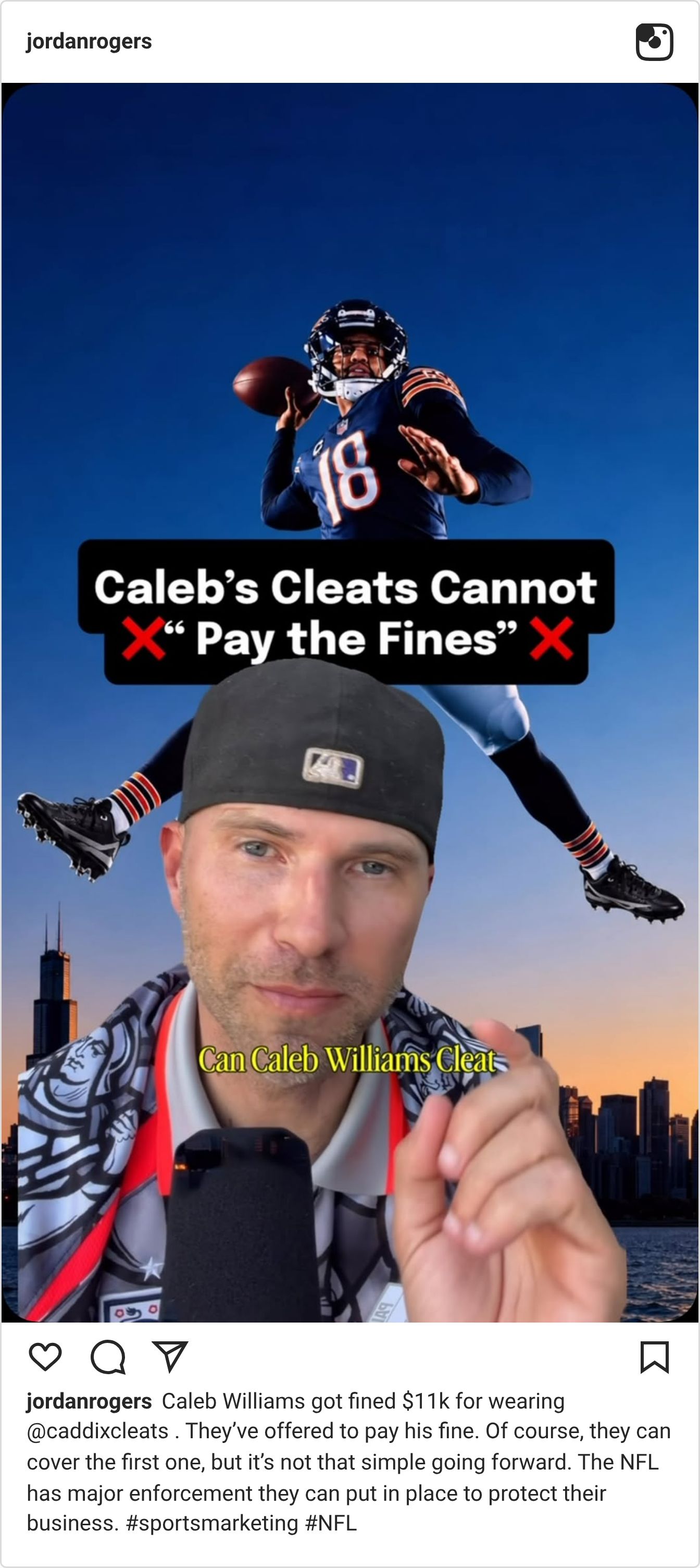
As Rogers points out, it’s the same reason Josh Allen wears blank New Balance cleats every week or Christian McCaffrey wears blank Bruce Bolt gloves.
Still, that doesn’t answer the question: if Williams, like over 40 other NFL players, has been wearing these cleats all season, why is he the only one getting fined now?
Streisand Effect: My best guess is it’s because Williams is quickly becoming one of the league’s biggest stars, and they don’t want their literal poster child giving free publicity to a competitor of one of their biggest sponsors.
However, what the NFL didn’t consider is that by fining him, they gave Caddix a bigger spotlight than they could have ever hoped for.
📉 Did the World Series Just Save Baseball?

What does this year’s World Series mean for the future of baseball?
Because even though the players will say it’s proof that baseball doesn’t need a salary cap, the league and its owners are spinning a very different story. Meanwhile, the truth is actually a lot more complicated than you might think.
The Arguments: It is true that this year’s Fall Classic featured two teams with bottom-half payrolls for the first time since 1991. So naturally, the players’ union is using it as an example of why baseball doesn’t need a salary cap.
But the league and its owners aren’t budging on their position. In fact, they’re using this series as evidence that a salary cap is needed. Commissioner Rob Manfred says that “a well-run franchise” like Milwaukee should be in the World Series more often but is disadvantaged by its small market size and lack of resources.
So who’s right here?
The Numbers: The Athletic actually analyzed the relationship between spending money and winning, and found that while MLB has the strongest correlation between payroll and winning of all the major sports leagues, a team’s spending on players actually only accounts for 17% of the variance in a team’s winning percentage, which is about the same as how many ground balls a team’s pitchers induce.

However, even that correlation basically disappears in the playoffs because of the extremely limited sample size.
Still, whether you side with the players and believe that a salary cap is equivalent to a “nuclear bomb” or you side with the league and its owners, who think it’s a necessary tool to help smaller market teams, one thing is for sure:
It’s unlikely that any of this gets figured out before the Dec. 1st deadline, which means baseball could be heading for another lockout.
🏆 Meet the Trainer Who Reinvented the Ankle Brace

What the heck is this device that hundreds of football players are suddenly wearing around their ankles?
Well, it actually helps solve one of the oldest problems in sports that no one seems to know anything about; let me explain.
Founder: This is Mike Bean. He’s been an athletic trainer for Notre Dame’s football team since 1995; however, after two decades on the job, he became concerned that simply taping up a sprained ankle didn’t provide much protection or stability.
Not to mention, it takes a lot of time to properly tape up an injured player, and those soft ankle braces most athletes grew up wearing are often uncomfortable and way too restrictive.
That’s why in 2014, he created the TayCo Brace, but what does it actually do?

Mike Bean
Prototype: Inspired by an external brace he saw a pregame paratrooper wearing, Mike decided that to achieve maximum stability and comfort, he needed to design a brace that sat outside the shoe. So he reached out to a local orthotics manufacturer in Indiana and began designing custom prototypes for his players at Notre Dame, who began wearing them that same season.
The benefit of wearing an ankle brace that sits outside the shoe, compared to one inside or a simple tape job, is that the extra width provides 2.5x more stability. This is also helped by the fact that it’s anchored to the bottom of a player’s cleat instead of being attached to a soft, movable sock.
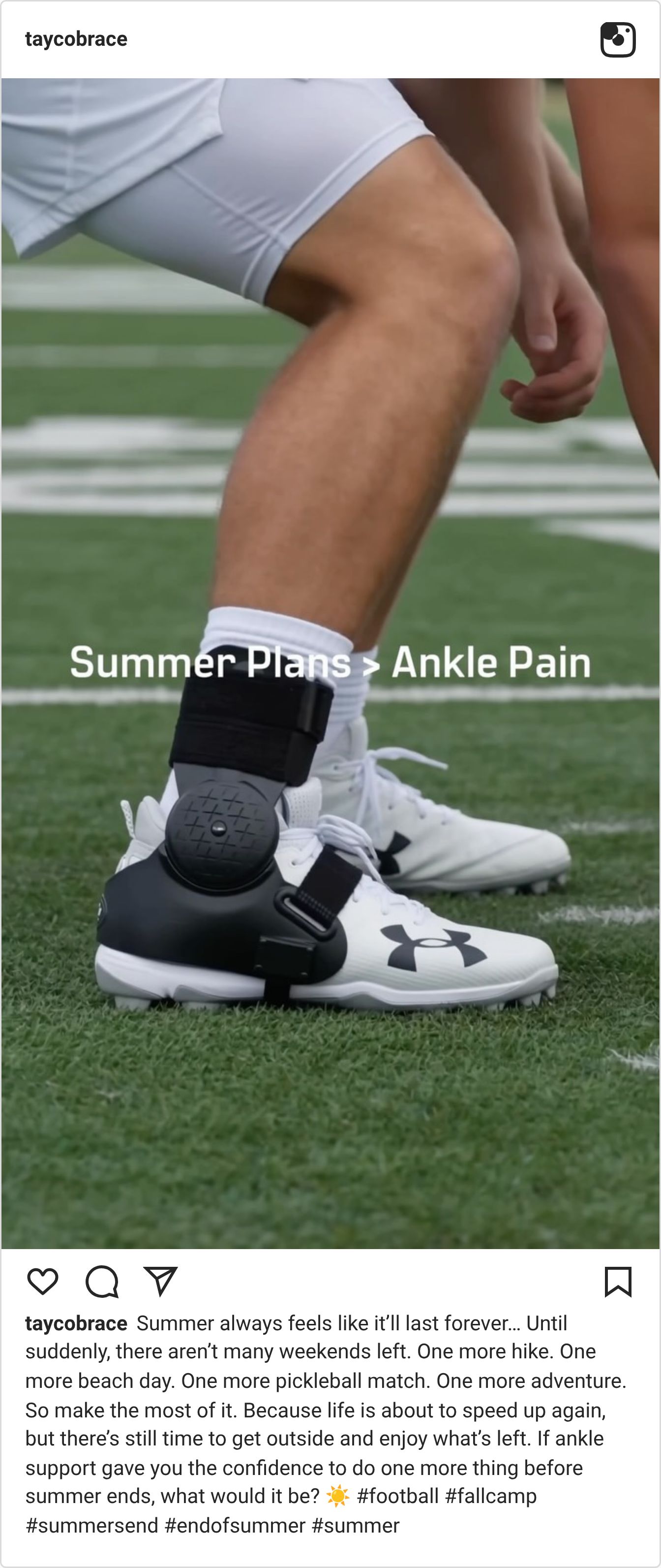
Now, even though this brace might look bulky, it actually hinges up and down freely. Meaning that while an athlete’s ankle is stabilized laterally and rotationally to protect against further injury, this brace doesn’t restrict explosive movements like running or jumping.
Still, that’s not even close to the best part.
Time Saver: Because for decades, in order to adequately put on an ankle brace or even just tape a player’s ankle, athletes have had to come out of the game, take their cleat off, and miss up to a quarter of the action. However, with Mike’s TayCo brace, players can put it on in seconds and miss no more than a play.
If you're interested in learning more about how it became adopted by almost every NFL team and more than 80 college programs in the last 10 years, check out my Wednesday newsletter with the company's CEO, Gavin Ferlic.
⏱️ In Other News
When you refer new readers to the Bottom of the Ninth, you win exclusive prizes.

➡️ Here is your unique link to share: {{rp_refer_url}}
You’re currently at {{rp_num_referrals}}. That’s only {{rp_num_referrals_until_next_milestone}} away from receiving {{rp_next_milestone_name}}!
*Please do not use fake email addresses — they will not qualify as referrals. Thank you!
👋🏻 Happy Friday!
As a Brewers fan, I enjoyed this:
